Table of Contents
- Overview
- 1. Fundamental Laws & Theorems of Boolean Algebra
- 2. Canonical and Standard Forms
- [[Boolean Algebra and Minimization#21-minterms-m_i-and-canonical-sop-csop|2.1 Minterms () and Canonical SOP (CSOP)]]
- [[Boolean Algebra and Minimization#22-maxterms-m_i-and-canonical-pos-cpos|2.2 Maxterms () and Canonical POS (CPOS)]]
- 2.3 Relationship Between Minterms and Maxterms
- 3. Karnaugh Maps (K-Maps)
- 3.1 K-Map Grid & Gray Code Ordering
- 3.2 Implicants, Prime Implicants (PI), and Essential Prime Implicants (EPI)
- 3.3 Minimization Procedure (SOP vs POS)
- [[Boolean Algebra and Minimization#3.4 Don’t Care Conditions ( or )|3.4 Don’t Care Conditions ( or )]]
- 4. GATE PYQ-Style Solved Questions
Digital logic circuits manipulate binary values ( and ) using mathematical structures formulated by George Boole. Boolean algebra provides the theoretical framework for simplifying complex logic expressions, reducing the physical gate count, power dissipation, and propagation delay of switching circuits.
In this note, we cover fundamental Boolean laws, minimization theorems (such as the Consensus Theorem and Shannon’s Expansion), canonical Sum-of-Products (SOP) and Product-of-Sums (POS) representations, and systematic graphical minimization using Karnaugh Maps (K-Maps).
1. Fundamental Laws & Theorems of Boolean Algebra
Boolean algebra operates over the set under two binary operations: OR () and AND (), alongside a unary operation NOT ( or ).
1.1 Standard Axioms and Basic Postulates
| Law / Property | OR Operation () | AND Operation () |
|---|---|---|
| Identity Law | ||
| Null (Dominance) Law | ||
| Idempotent Law | ||
| Complementarity Law | ||
| Involution Law | ||
| Commutative Law | ||
| Associative Law | ||
| Distributive Law | ||
| De Morgan’s Laws |
IMPORTANT
The second distributive law is unique to Boolean algebra! Unlike conventional arithmetic, addition distributes over multiplication in Boolean logic.
1.2 Absorption & Elimination Laws
Absorption Theorem 1
Absorption (Elimination) Theorem 2
By Distributive Law:
1.3 Consensus (Redundancy) Theorem
The Consensus Theorem is one of the most powerful simplification rules in GATE problems. It allows eliminating a redundant term from a 3-variable expression.
SOP Form of Consensus Theorem
Conditions for Consensus Reduction:
- There must be 3 variables ().
- One variable appears in both uncomplemented () and complemented () forms across two terms.
- The third term () consists of the remaining literal factors of the first two terms. This third term is redundant and can be deleted!
POS Form of Consensus Theorem (Dual)
1.4 Transposition & Shannon’s Expansion Theorems
Transposition Theorem
Shannon’s Expansion Theorem
Any Boolean function can be expanded with respect to any variable :
NOTE
Shannon’s expansion is the mathematical foundation for realizing any Boolean function using a 2-to-1 Multiplexer (MUX)!
2. Canonical and Standard Forms
2.1 Minterms () and Canonical SOP (CSOP)
A minterm is a product (AND) of all variables in the function, where each variable appears exactly once in either its uncomplemented or complemented form.
For an -variable function, there are distinct minterms.
- In minterm notation: Uncomplemented literal = , Complemented literal = .
- Example for 3 variables ():
- ().
Canonical Sum of Products (CSOP)
A Boolean expression is in CSOP form if it is expressed as a logical sum (OR) of distinct minterms for which the function output is :
2.2 Maxterms () and Canonical POS (CPOS)
A maxterm is a sum (OR) of all variables in the function, where each variable appears exactly once in either complemented or uncomplemented form.
- In maxterm notation: Uncomplemented literal = , Complemented literal = .
- Example for 3 variables ():
- ().
Canonical Product of Sums (CPOS)
A Boolean expression is in CPOS form if it is expressed as a logical product (AND) of distinct maxterms for which the function output is :
2.3 Relationship Between Minterms and Maxterms
For any minterm and maxterm with identical index :
Furthermore, if a function is defined by its minterm set , its complement is defined by the remaining minterms, and its POS representation is the product of maxterms belonging to the complementary set:
3. Karnaugh Maps (K-Maps)
A Karnaugh Map (K-Map) is a graphical tool used to minimize Boolean expressions without performing manual algebraic manipulations. It arranges minterms on a multidimensional grid where adjacent cells differ by exactly 1 bit.
3.1 K-Map Grid & Gray Code Ordering
To preserve single-bit adjacency between neighbouring cells, K-Map rows and columns are ordered using Gray Code:
4-Variable K-Map Layout ()
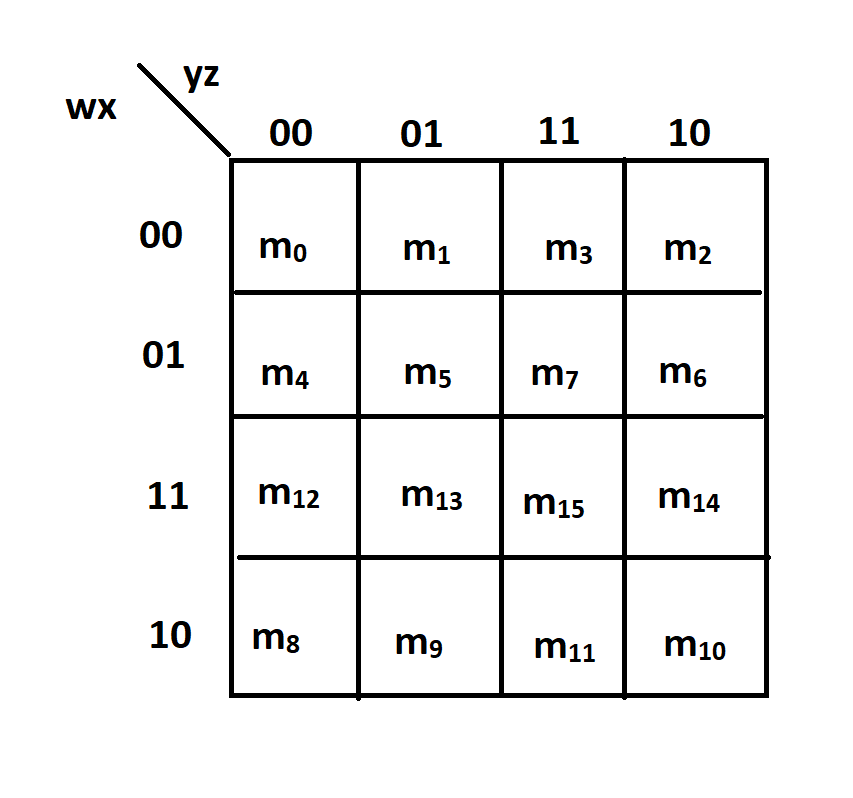
| 00 () | 01 () | 11 () | 10 () | |
|---|---|---|---|---|
| 00 () | ||||
| 01 () | ||||
| 11 () | ||||
| 10 () |
WARNING
Note the non-binary sequence in the third row and column ( comes before )! This Gray code ordering ensures that top/bottom and left/right edges fold around and are adjacent.
3.2 Implicants, Prime Implicants (PI), and Essential Prime Implicants (EPI)
Understanding these definitions is critical for GATE questions on minimal expressions:
- Implicant: Any individual minterm or group of adjacent (of size ) in a K-Map.
- Prime Implicant (PI): A rectangular group of (size ) that cannot be subsumed into a larger valid group. A PI corresponds to a product term with a minimal number of literals.
- Essential Prime Implicant (EPI): A Prime Implicant that contains at least one minterm () that is not covered by any other Prime Implicant.
- Rule: Every EPI must be included in the final minimal Boolean expression!
- Redundant Prime Implicant (RPI): A Prime Implicant whose constituent are entirely covered by EPIs. An RPI is excluded from the minimal expression.
3.3 Minimization Procedure (SOP vs POS)
Steps for Minimal SOP:
- Plot for minterms and for Don’t Care conditions in the K-Map grid.
- Form the largest possible groups of adjacent (groups must be powers of 2: ).
- Identify all Essential Prime Implicants (EPIs) and include them in the expression.
- Cover any remaining using the minimal set of additional PIs.
Steps for Minimal POS:
- Group instead of in the K-Map.
- Write product of sums for each group (inverting variables: , ).
3.4 Don’t Care Conditions ( or )
In many practical circuits (e.g., BCD to 7-segment decoders), certain input combinations never occur or their output does not affect system operation. These are Don’t Care conditions ( or ).
Rules for Handling Don’t Cares ():
- You may treat an as a if and only if it helps create a larger group (reducing literals).
- You may treat an as a if it does not help enlarge any group.
- An never forces the creation of a new PI on its own (a group consisting purely of cells is invalid and ignored).
4. GATE PYQ-Style Solved Questions
Q1) Simplify the Boolean expression: F(A, B, C) = AB + \bar{A}C + BC
Sol - Recognize this directly as the Consensus (Redundancy) Theorem:
- Variables: .
- Complemented variable: and .
- Terms: contains , contains .
- The consensus term formed by combining remaining variables is .
Applying Consensus Theorem:
Q2) Determine the total number of Prime Implicants (PI) and Essential Prime Implicants (EPI) for the Boolean function: F(A, B, C, D) = \sum m(0, 2, 5, 7, 8, 10, 13, 15)
Sol - Let’s plot minterms on the 4-variable K-Map:
-
Minterms occupy the 4 corners of the K-Map!
- Grouping all 4 corner cells forms a quad: .
- Minterms are uniquely covered by this corner quad. Hence, is an EPI.
-
Minterms occupy columns 01 and 11 in rows 01 and 11.
- Grouping these 4 cells forms a quad: .
- Minterms are uniquely covered by this quad. Hence, is an EPI.
Summary:
- Total Prime Implicants (PI) = 2 ( and ).
- Both PIs are Essential Prime Implicants (EPI) = 2.
- Minimal Expression: .