Approximations
We can approximate the value at any point of the curve by using polynomials of increasing orders.
Linear Approximation
Consider a point on the graph at which we wish to approximate the value of the function using a line centered around some . We center at because the approximation is fundamentally about local behavior, and locality is measured relative to the point you care about.
The equation of this approximation line would be . Around some really small neighbourhood around we can say that the curve of the graph and the line coincide, thus .
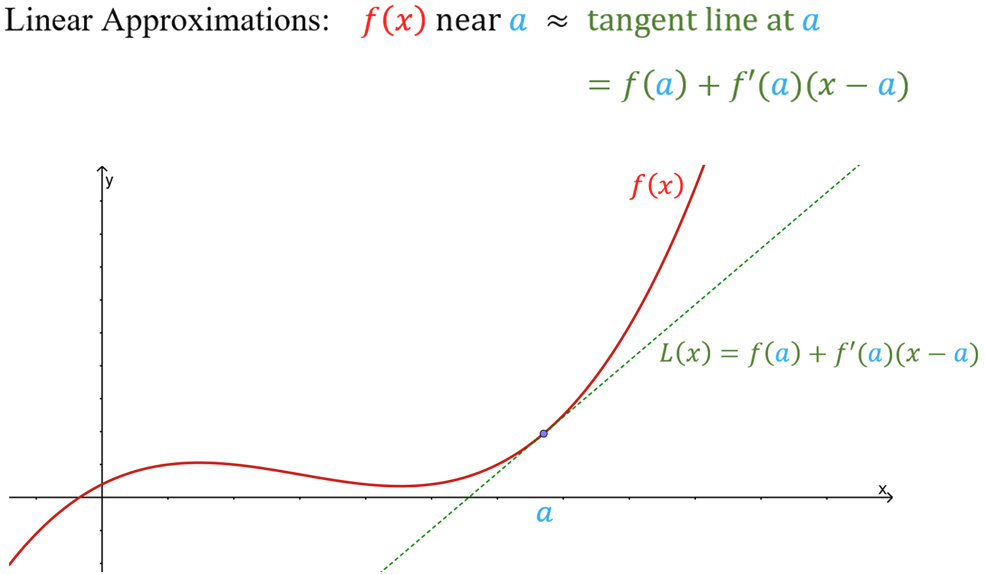
By plugging in we can get . Due to this we can even say that,
Using this information we can finalize it all by doing,
If we consider a fixed point instead of and we wish to find the value of any point some distance away from , we can rewrite the above equations as
This is the First-Order Approximation of a function, also called as the Linear Approximation.
Quadratic Approximation
Similar to how we had a linear centered around for linear approximation, we can also have a parabola centered around for a second order approximation of the function. This parabola can be represented as,
Again, by plugging in we get that . As in some neighbourhood around the parabola and the curve of the graph would coincide, we can say that .
We can get by doing,
We can get by taking the derivative of and solving for .
By putting it all together we get,
or if we write this in the terms of , we get
This same method can then be extended to higher degrees to get higher order approximations of a function. That’s the Taylor Series.
Taylor Series
The Taylor series provides a higher order approximation for a function’s value around some neighbourhood of any point .
Cauchy Schwarz Inequality
Directional Derivative
Direction of steepest descent is . This can be shown by either using the Cauchy Schwarz Inequality or Taylor Series.